Finding meaning in the moment, magic in the mundane, and, most of all, adventure in the living
Thursday, July 5, 2012
Fertility Awareness Method (FAM) for Birth Control, Conceiving, and Beyond
I've labeled this post as "media recommendations" but also as "other recommendations" because, beyond recommending this particular book, I am recommending getting educated about fertility awareness.
I hope this is not a taboo topic to post about on a blog. Because I think it is something that should be shared. (Thanks to my wonderful sister-in-law for sharing it with me and to whoever shared it with her before that.) I also think it is something that is not shared nearly often enough. In the "marriage intimacy preparation" course I took from BYU's Student Health Center, for example, the physician teaching the class barely mentioned this option while going over her "birth control" chart. On the other hand, probably a solid 30 minutes were spent talking about the pill. Now, granted, the newlywed years may not be the most ideal time for practicing FAM as a method of birth control, but I think this represents a common attitude among medical professionals. What is the message there? That this FAM is too complicated for the average patient to understand? Requires too much self-control? Does anyone else find that just a little bit insulting? But I digress.
FAM as Birth Conrol
Let's get this straight I am NOT recommending FAM as a method of birth control for everyone; obviously, it will not be a good fit for many people, and even those for whom it is will probably only practice it during certain times in their lives (for example, it may not be the best method for women who are partially-breast feeding). What I AM recommending is discovering what it actually is and then considering it as a birth control option -especially if you are sensitive to hormonal birth control methods like I am. (Even on the "mild symptom" Nuva Ring, I was starting to get used to near-constant hunger cravings and a daily bout with nausea in the late afternoons.)
Not to go into too much detail, but there is nothing mysterious, hoodo voodoo, or pseudoscience about fertility awareness. Actually, it is a perfectly logical idea: learn how to tell when you are fertile and then adjust your love life accordingly. Did you know that the woman is actually only fertile for a couple of days each cycle (her egg only stays alive for a day or so)? But taking the man's fertility into account (he is always fertile and his sperm can stay alive for about 5 days), that totals 1-2 weeks of combined fertility. Amazingly, our bodies will let us know when we are in that fertile zone. If we know what to look for.
The other thing I wanted to mention is that you can be as conservative as you want to be with this method. Follow the rules exactly, and you're covered. However, during months when your body isn't sending as clear of signals (anovulatory cycles, for instance) or anytime you don't feel 100% confident, take extra precautions. (During the first 5 days of my period is an example of a time when I feel 100% confident. Another time is a couple of days after I have charted a clear ovulatory temperature shift.)
And finally, I like that the man can be a more active participant in this method (Dave actually writes my temperatures down in my chart most mornings).
FAM to Conceive
When we were trying to get pregnant with Peter, I had a pretty strong inkling that we'd conceived long before I got the positive test result. That's because I was acutely aware of when I had ovulated. If we were struggling to get pregnant, or we just wanted to maximize our chances for a particular month, it would make perfect sense to start with fertility awareness.
FAM for General Body Awareness
I like trying to figure out what my body is doing. I like knowing where I am at -hormonal-ly- in my cycle. Am I more hungry, tired, or anxious at different points in my cycle? Am I ovulating normally? For example, there were a few months last winter when I was suffering with some insomnia/anxiety and my charting was all over the place (I think I had some anovulatory months). Anyway, it was another indication to me that something was "off" with my body. I think this book lists some other great benefits, but (confession) I never finished the last few chapters. Not because the book was intimidating though. Weschler makes it all very user-friendly and throws in plenty of humor for good measure.
I didn't give many details, but this blog post (random blog I ran across when searching for the picture) seemed to do a good job at dispelling several myths.
http://brightonwoman.blogspot.com/2009/03/fertility-awareness-method-fam.html
Daylily Days


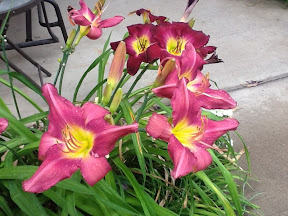
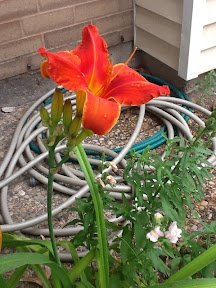
Finally. That long-awaited, joyful time has come. No, not the holiday season. But what I call the Logan Daylily Season. Almost anywhere you look in the city you will see their bright colors --apartment complexes, residential streets, business landscaping. If the Logan area had an official flower, it would have to be the daylily. Low-maintenance, tidy, green, leafy bushes all summer long, and, for one glorious month, a deluge of blossoms like those pictured above.
To explain, the individual blossoms do not last for weeks. The blossoms -befitting their name- only open their petals to the world for one day before closing -to make room for the next day's array of blooms. I couldn't help feeling sad when I learned this (the summer we moved into our already-landscaped-with-daylilies-condo), but soon realized that, with so many buds per stem, we would not be lacking in the daylily department.
I wanted my pictures to show the flowers at their zenith - the week or so when the most blossoms are open at once -but think I was a bit late. They'll now be tapering off until only one or two buds remain per stem (a great time for finally being able to use them as cut flowers, however). It still makes me a little sad though, on days when I don't get out to admire their display, that I missed an entire composition of changing colors, angles, and proportions. I think there's something symbolic there for me -something about how quickly the grand days of summer always seem to go.
Monday, July 2, 2012
Scrubs Love
I'm a little ashamed to admit -and probably should be more ashamed than I actually am- but I think this is my favorite TV show. Ever. It was only last summer that I finished Season Eight, but just the other night Dave and I went back to Season One to start re-watching episodes. I actually get cravings for this show. I could do without most of the sexual humor (most of which I cringe through), and I'm especially bugged by all the J.D./Elliot casual sleeping around. But still, how does a show that regularly features floating-head-doctor daydream sequences (and there's a lot more ridiculousness where that came from) manage to feel so darn real? So full of heart?
How
many other comedies could pull off a storyline as heavy the Doctor-Cox-fails-to-save-three-patients-and-his-friends-have-to-pull-him-out-of-a-drunken-stupor one--while still making you laugh out loud every couple of minutes?
There is this delicate, magical balance of the funny with the sad,
the mundane with the profound, and Scrubs makes it all look so
easy. Unlike 30 Rock or Malcolm in the Middle (comedies
I've also been enjoying lately) Scrubs usually leaves me with
something meaty to chew on. You know, questions like: What are the
ethics of modern health care? What does it mean to be a mentor? A
friend? What's the best way to deal with death? Change? Lots of
medical dramas ask these same types of questions, but I think it's
the subtlety, warmth, and humor with which Scrubs does it that is so
effective.
It's
a show that evolves. Characters and relationships develop believably.
Take doctor Kelso. Yes, he is the penny-pinching, cantankerous chief
of medicine, but a flat character he most definitely is not, or at
least does not remain so for long; by the end of the series, Bob
Kelso is one of the show's most sympathetic characters (watch some of
the episodes after he has retired if you don't believe me -or the
episode told from his point of view).
The writing is creative and often unexpected. There's an episode done as a musical, an episode told from the eyes of relatively minor characters, an episode which follows a day's chain of events and then goes back and follows them again as they might have occurred. There's the gut-wrenching twist endings, sweet surprise endings, and everything in between. There is none of the formulaic script-writing of House, none of the forced wittiness of Gilmore Girls.
The acting is spot-on --with lots of fun guest-star appearances too (see Micheal J. Fox as an OCD doctor, Dick Van Dyke as one of Doctor Kelso's old friends, Brendan Frasier as Doctor Cox's brother-in-law). But it's really the details that bring everything together for me. The soundtrack, the elaborate day-dreams, the little quirks that make you love the characters, the careful way that events come together. The rough-around-the-edges sincerity. The unabashed goofiness. The heart. And, of course, The Janitor. :)
The writing is creative and often unexpected. There's an episode done as a musical, an episode told from the eyes of relatively minor characters, an episode which follows a day's chain of events and then goes back and follows them again as they might have occurred. There's the gut-wrenching twist endings, sweet surprise endings, and everything in between. There is none of the formulaic script-writing of House, none of the forced wittiness of Gilmore Girls.
The acting is spot-on --with lots of fun guest-star appearances too (see Micheal J. Fox as an OCD doctor, Dick Van Dyke as one of Doctor Kelso's old friends, Brendan Frasier as Doctor Cox's brother-in-law). But it's really the details that bring everything together for me. The soundtrack, the elaborate day-dreams, the little quirks that make you love the characters, the careful way that events come together. The rough-around-the-edges sincerity. The unabashed goofiness. The heart. And, of course, The Janitor. :)
Thursday, June 14, 2012
Stop and Smell the Roses
(I took a public speaking class in college and always regretted not having given my persuasive speech on this topic. Decided it wasn't too late.) :)
“Stop and smell the roses” has always been one of my favorite sayings. As a child, I took the advice quite literally, and there are dozens of photographs of little me to prove it. Of course, this gem of wisdom goes well beyond flowers. To stop, to slow down, to smell, appreciate, and more fully experience our world suggests, nothing short of, an entirely new way of living. But how do you say, “slow down,” let only live the idea, in our culture of capitalism? -In a culture that, above all else, values efficiency and success, albeit a rather narrow definition of the word. To quote Adam Smith's 1776, The Wealth of Nations, in a free-market economy, “every individual necessarily labors to render the annual revenue of society as great as he can.” In other words, to increase the Gross National Product.
In this regard, at least, I think we
have succeeded. Consider the floating island of waste in the North
Pacific. Consider that in most households both adults work long hours
week after week after week, and, if lucky, will receive two or three
weeks paid vacation each
year. Consider that we have increased our daily intake by at least
300 calories per day since 1985; consider that, for the sake of
efficiency, we now ingest a reported fifth of
these daily calories in the car. Consider the national rates of heart
disease and obesity; our population simply can't increase our demand
for food as quickly as the food industry can produce more of it. (In
the spirit of increasing revenue, however, the industry has largely
overcome this hurdle with marketing campaigns such as “supersizing”
and other insidious changes to our way of eating -the full effects of
which still remain largely undetermined.)
In a culture driven
by producing and consuming ever-more stuff, “slowing down” may
not be as simple as it sounds. It may not even be a solution. But
maybe, just maybe, it is. “Slow Food” is the name of a movement
that began in Italy in the 1980s to combat our increasingly
fast-paced way of life. They emphasize savoring good food, eaten in
good company. Their messages is that a slower, more thoughtful, more
appreciative way of eating and living would not only improve our
health, but have other cultural benefits as well.
Considers this
example. What might the effects be if we reinstated the seemingly
fundamental -but ever diminishing- family meal. To paraphrase some of
Micheal Pollan's ideas from his book, In Defense of Food,
children might learn more patience if they had to wait between meals
rather than popping a frozen entree into the microwave at the first
twinges of hunger. They might learn to control their portion sizes.
And wouldn't children and adults alike appreciate and, therefore,
waste less food if they had taken some part in the preparation or
clean-up of the meal? What's more, children might learn social skills
such as table manners and polite conversation -not to mention an
overall deepening of family relationships- if we just took the time
to sit down together and eat.
But that's just it,
isn't it? We simply don't have the time. Or do we? In less than two
decades, the average American has somehow found the time to add 1-2
hours spent on the internet every day. Clearly, there is a balance of
priorities involved as well. Aside from eating well and eating
together, what else do we no longer have the time for? Walking to
school or work -or walking anywhere, for that matter. Stopping to
chat. With the advent of the self-check-out line, we can now complete
an entire shopping experience without ever having to stop and
interact with anyone.
Perhaps
most distressing of all, we don't have time for solitude and for
meditation. Even in our moments of alone time, is there any room for
deep contemplation -for introspection- given the near-constant
buzzing from phone calls, texts, emails and face-book notifications
coming from the mobile device in our pocket? Can we even call it
“alone time” anymore? To paraphrase from an article by Stephan
Marchie titled “Is Facebook Making Us Lonely?” the author
concludes that one of the most interesting phenomenons of social
media isn’t that is is making us more lonely, but rather, that it
is changing the very nature of solitude itself. Whereas these moments
may have once been spent marveling at nature or searching our souls,
they are now increasingly spent contemplating our next status update
or wondering what vacation pictures we should post online; In other
words, we are spending a lot more time thinking about the digital
version of ourselves that we wish to present, rather than thinking
about the version of ourselves that we actually are.
I am
not suggesting that we throw away our mobile devices and head for the
hills to “find ourselves.” What I am suggesting, though, is that
we see more, notice more, and appreciate more in our day-to-day
living. I'm convinced that doing so will improve our physical health
as well as our internal sense of identity, awareness, and well-being.
What is the power of noticing?
Well, Barbara Ann Kipfer's, 14,000 Things to be Happy About
gives us some idea. Kipfer didn't start out meaning to write this
book. She simply noticed, enjoyed, and recorded the “little things”
in life -, flannel sheets, ice cream sandwiches, sun burning off the
morning fog. She often jotted down her observations on receipts,
napkins, or whatever piece of scrap-paper happened to be available at
the time. And yet, her impressive compilation of “happy thoughts”
has become beloved by thousands of Americans -it's message of
“enjoying the little things” incorporated into various
mental-health therapeutic approaches.
On a more personal
note, in college, I was able to room with one of my best friends who
was then -and is now- an inspiration to me on this topic. Every
night, no matter how tired, now matter how late the hour, she would
write down five “things to be happy about” from that day. Given
her depression and struggle with other health problems, this wasn't
always such an easy a task. And yet, she persevered. Years of
experience with medications, physicians, counselors and various
treatments, and she had come to the conclusion that this one simple
exercise was perhaps the most powerful treatment of them all.
So try
noticing life. Slow down. Make
time for the important things. Take time for the little things. Stop.
Smell. Enjoy life's roses.
Monday, June 11, 2012
The Stuff of Parenthood: Top 8 for Pregnancy (i.e. How I Survived)
1) Slim-Rite Breakfast Drinks
I think these truly saved my life (or at least saved me from a lot of unpleasant retching). Now, I'm no fan of diet drinks, but I tried everything else (graham crackers, ginger cookies, chocolate milk, juice) and these babies were the only thing that I could get down in the morning (I'd chug one with a straw before even getting out of bed) that would really stave off the nausea until lunchtime.
2) One-Piece Garments
For those of you that are of the LDS faith, I had to share this discovery. If you can't find them at a distribution center, they are easy to buy online from the church store. Basically, no seems pushing into your baby bump = comfort. Shirt has a much cuter fit over baby as well. Plus, you know those maternity pants panels? They will actually stay up when worn over these (must be cotton-blend, not silky texture, though).
3) Water, Water, Everywhere!
Okay, I know this is not the environmentally-friendly route, but I think having a case of water bottles in my office at work probably saved me from dying of thirst on more than one occasion (melodramatic you say? -try being pregnant and just see just how thirsty you get!) You wouldn't believe how difficult it can be to find a moment to simply walk down the hall and refill your water bottle when you are scrambling to clean up from your previous therapy session and prepare for the next! (Also, for working mommies, do whatever you can to schedule your lunch time for as long as you can. Skipping lunch will no longer be an option).
I also dreamed about finding a big water mug like this one the whole summer that I was pregnant (and eventually did, ironically, after giving birth):
4) Snacks Galore
For my bedroom, I filled a crate with juice boxes and munchies. Because, so often, I'd wake up in the night to pee, but then realize that I couldn't go back to sleep because I was so hungry! Having some middle-of-night munchies on hand was especially good for living in a town-home style condo. (Who wants to go downstairs to the cold, dark kitchen in the middle of the night?)
5) Body Pillow
Being a stomach-sleeper, I was really worried about having to switch to my side. With a pillow like this though, it wasn't even an issue. I found a happy in-between-stomach-and-side position. A lot like this lady is demonstrating:
I think these truly saved my life (or at least saved me from a lot of unpleasant retching). Now, I'm no fan of diet drinks, but I tried everything else (graham crackers, ginger cookies, chocolate milk, juice) and these babies were the only thing that I could get down in the morning (I'd chug one with a straw before even getting out of bed) that would really stave off the nausea until lunchtime.
2) One-Piece Garments
For those of you that are of the LDS faith, I had to share this discovery. If you can't find them at a distribution center, they are easy to buy online from the church store. Basically, no seems pushing into your baby bump = comfort. Shirt has a much cuter fit over baby as well. Plus, you know those maternity pants panels? They will actually stay up when worn over these (must be cotton-blend, not silky texture, though).
3) Water, Water, Everywhere!
Okay, I know this is not the environmentally-friendly route, but I think having a case of water bottles in my office at work probably saved me from dying of thirst on more than one occasion (melodramatic you say? -try being pregnant and just see just how thirsty you get!) You wouldn't believe how difficult it can be to find a moment to simply walk down the hall and refill your water bottle when you are scrambling to clean up from your previous therapy session and prepare for the next! (Also, for working mommies, do whatever you can to schedule your lunch time for as long as you can. Skipping lunch will no longer be an option).
I also dreamed about finding a big water mug like this one the whole summer that I was pregnant (and eventually did, ironically, after giving birth):
4) Snacks Galore
For my bedroom, I filled a crate with juice boxes and munchies. Because, so often, I'd wake up in the night to pee, but then realize that I couldn't go back to sleep because I was so hungry! Having some middle-of-night munchies on hand was especially good for living in a town-home style condo. (Who wants to go downstairs to the cold, dark kitchen in the middle of the night?)
5) Body Pillow
Being a stomach-sleeper, I was really worried about having to switch to my side. With a pillow like this though, it wasn't even an issue. I found a happy in-between-stomach-and-side position. A lot like this lady is demonstrating:
6) Lower-back Pillow for Car
Long car trips were brutal beyond 7 months. A pillow like this behind my back alleviated some of the discomfort though.
7) The Hair-Band-in-Button-Hole Trick
Learned this one from a coworker. Enabled me to wear my work pants through the school year and thereby to put-off buying maternity pants until summer (at which point, I only needed to buy a few pairs of crops).
8) Drawstring Pants
Even better than maternity pants for comfort in my experience. Can also be cuter (believe it or not) and can be worn before and after giving birth. Do yourself the favor that I didn't and have a lot of these stocked up in your closet when you return from the hospital. (Make sure there is a nice wide, stretchy waist band, like in this picture.)
What got you through pregnancy? I'd love to hear your ideas. :)
Cache Valley Gardener's Market
I know I posted on this topic a couple of years ago, but, since then, my love for the Cache Valley Gardener's Market has only grown! There's something about the local, friendly, wholesome goodness of it all that I can't resist. I love seeing the creative expressions of my fellow Cache Valleyians. I love the local chefs celebrating their ethnic heritage. I love buying my food from the very person who grew it. I'm sure having just finished "In Defense of Food" by Micheal Pollan has only increased my zeal, but I love biting into a locally grown tomato and knowing it is so much better for me -not to mention for the environment- than a store-bought one. (I hope there is an additional placebo effect going on here to, because I can almost picture the nutrients flooding my body when I bite into that local, leafy goodness.)
This season, Dave and I signed up for a half-share in a CSA (community supported agriculture). For $260 bucks and we'll get a bag of produce every week from now through the end of December. We love seeing what comes into season each week (sorrell, anyone? loveage?) and then discovering what to do with it. Gooooo local! (said like a cheerleader chant, not a command, btw) :)
Friday, April 6, 2012
The Stuff of Parenthood: The Hardest Part
Already posted on the best part of being a mom. So what was the hardest part of having a newborn? The sleep deprivation? The 3 A.M. feedings? The cry-fest between the hours of 5:00 and 9:00 P.M.? The transformation of your old way of life? For me, it was all of these things. But, again, it's really the bigger picture represented by those things. For me, it was the "loss of control."
I think of it this way. When I was working, was I any less stressed? Absolutely not. What's more, did I have any more free time? Nope, definitely had less. But the thing is, what time I had was MY free time; even if I only had an hour of it, I could count on at least that solid, uninterrupted hour to do, well, whatever I wanted. Enter baby. Baby goes down for a nap. I should have a couple hours of free time, right? But then, with baby in the picture now, nothing is guaranteed. Baby could wake up screaming -needing me- in 60 minutes, 30 minutes, 10 minutes. You just don't know. You could get wrenched out of a beautiful nap, interrupted half-way through unloading the dishwasher, pulled out of an important phone call. Your time -your life- is simply no longer your own. You have lost control. Try to embrace it.
Subscribe to:
Posts (Atom)